At Christie Health Centre, we believe that healing happens when the body and mind are understood together. One powerful way to deepen that understanding is through Polyvagal Nervous System Mapping, a perspective rooted in how your nervous system senses safety, danger, connection, and calm. So often, people feel confused by their own reactions: “Why do I shut down?” “Why do I get so anxious so fast?” “Why can’t I calm down even when I know I’m safe?” Polyvagal Nervous System Mapping offers a deeply compassionate answer: your nervous system is doing exactly what it was designed to do — protect you. And once we understand how it works, we can begin to work with it rather than against it. The mapping can help you explore what it feels like in your body when you’re relaxed, stressed, overwhelmed, or shut down — and learn how to support yourself toward deeper regulation and wellbeing through psychotherapy, osteopathy, and massage therapy.
“In therapy, we don’t merely reduce symptoms — we help clients create new nervous system experiences of safety that expand their capacity for connection and choice.”
— Deb Dana
Our nervous system isn’t just about “fight or flight” or “rest and digest.” According to the Polyvagal Theory, developed by neuroscientist Stephen Porges, we have a hierarchy of physiological states governed by the vagus nerve, a major nerve connecting the brain to the body that helps regulate heart rate, breathing, digestion, and emotional states.
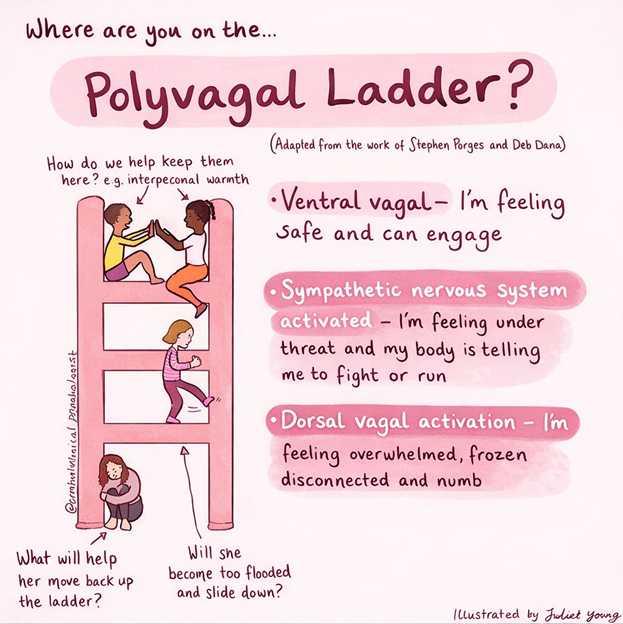
This framework describes three primary nervous system states:
This is the state where you feel grounded, open, calm, and connected — to yourself and others. Your body feels more regulated, your breathing is steady, and you’re able to think clearly and engage in relationships.
This is the activation state. You might feel anxious, irritable, restless, overwhelmed, or tense. Your body mobilizes energy to respond to threat — even if the threat is emotional, relational, or internal.
This is the state of disconnection, numbness, fatigue, or emotional shutdown. You might feel foggy, unmotivated, withdrawn, or like you can’t access your feelings. This is the nervous system’s protective “freeze” response when it senses that fight/flight isn’t possible.
Many people blame themselves for feeling anxious, reactive, numb, or stuck. But often, these patterns are not personal failures, they’re nervous system responses shaped by lived experience.
Polyvagal mapping helps you shift from:
“What’s wrong with me?”
to
“What happened to me, and what is my body trying to protect me from?”
At Christie Health Centre, we often see that emotional patterns are also held in the body — through tension, pain, shallow breathing, digestive issues, headaches, fatigue, or chronic stress. Mapping your nervous system can help you recognize these patterns with more clarity and compassion.
Polyvagal mapping is a therapeutic process that helps you identify:
It’s a way of building self-awareness and learning how to respond earlier — before you reach overwhelm or collapse.
At Christie Health Centre, we recognize that nervous system healing often requires more than insight alone. It also requires the body to feel safe enough to shift out of survival mode.
Depending on your needs, support may include:
When combined intentionally, these approaches can help create a deeper sense of regulation, both emotionally and physically.
You may benefit from nervous system mapping if you experience:
These patterns are often the nervous system’s way of trying to survive and they can shift with the right support.
A regulated nervous system doesn’t mean you never feel stress. It means you can move through stress and return to safety.
Healing is about building flexibility and the ability to notice what’s happening inside you and respond with care instead of fear, self-judgment, or collapse.
Polyvagal mapping helps you practice that flexibility with greater awareness, gentleness, and intention.
At Christie Health Centre, we believe that nervous system healing is possible — even if you’ve been stuck in survival mode for years. When you begin to understand your body’s protective patterns, you can start building a new relationship with yourself: one rooted in compassion, curiosity, and support.
Whether you’re navigating anxiety, trauma, emotional shutdown, chronic stress, or tension held in the body, polyvagal mapping can be a meaningful pathway toward greater regulation, resilience, and connection, supported through therapy, osteopathy, and massage care.

Written by Dagmara Guy, who is a Registered Psychotherapist and new therapist at Christie Integrated Health Clinic. She is a psychodynamic and attachment-oriented therapist who explores how early relationships shape the nervous system, identity, and our capacity for connection. Her work weaves together depth psychology, trauma-informed care, and nervous system–informed approaches to support clients in moving from survival patterns toward greater regulation, self-trust, and wholeness. With a warm, relational presence and deep respect for the body’s wisdom, Dagmara helps clients gently uncover the roots beneath symptoms, making space for healing, meaning, and lasting inner change.
If there’s something you’ve always wanted to ask about your health, your nervous system, or what’s happening in your body—send it my way. I’d love to include your questions (anonymously, of course) in future posts.
You can email me directly at kevin.janna@gmail.com or drop a note through the new site: christiehealth.ca
Thanks again for being part of this journey. Here’s to presence, healing, and the practice of simply showing up.